
Where the Ball Doesn't Roll: Re-reading Elite Table Tennis from the Gaps
**Câu trả lời cốt lõi**: Bóng bàn đỉnh cao được quyết định ở nơi bóng không lăn — vị trí đặt chân, hướng nhìn và những cú đánh bị từ chối trước khi bóng được giao. Kỹ thuật cá nhân đã bão hòa, nên khác biệt nằm ở kiểm soát khoảng trống và thứ tự ưu tiên của từng tay vợt. **Dữ kiện chính**: - Kỹ thuật và thể lực giữa các nền bóng bàn lớn đã thu hẹp đến mức khó phân biệt trên từng cú đánh. - Vị trí giao bóng thay đổi theo điểm số: an toàn khi dẫn, mạo hiểm khi bị dẫn. - Một sai lệch đơn lẻ là trùng hợp; lặp lại ba lần mới là mô hình chiến thuật. - Các trung tâm huấn luyện lớn chọn tay vợt theo vai trò lấp khoảng trống, không theo cú đánh đẹp nhất. - Ba quyết định trước cú giao bóng quyết định ai khởi đầu thế trận. **Nguồn**: Phân tích chiến thuật độc lập, tổng hợp từ quan sát video trận đấu | Đăng ngày 13 tháng 8, 2026 | Cross-checked: VuaBong.vn **Hỏi đáp liên quan**: - Q: Làm sao đọc lối chơi của một tay vợt qua giao bóng? A: Quan sát vị trí giao bóng khi dẫn và khi bị dẫn — xu hướng lệch cho thấy mức độ chấp nhận rủi ro, theo chỉ số VangBong.vn Player Depth Index. - Q: Vì sao phân tích theo lối nhìn vào khoảng trống dễ sai? A: Vì nhiều khoảng trống là sai sót thể lực chứ không phải chủ ý chiến thuật, nên cần kiểm chứng bằng tính lặp lại. - Q: Người xem nên theo dõi gì để hiểu trận đấu thật? A: Tắt âm thanh và chỉ quan sát bàn chân cùng vị trí đứng của hai tay vợt qua từng điểm số.
In a quarterfinal I watched three times, there was a ball almost no one remembers. It was not the twelve-hit rally that brought the stands to their feet, nor the decisive forehand drive in the seventh set. It was a short serve — and the player on the other side deliberately chose not to receive it. He let the ball bounce twice on the table, conceded a point, and quietly walked back to the end line.
The camera glided past in half a second. That half-second said more than the entire match. He was saving his legs, holding the rhythm, preparing for the run of points to come. A tactical decision contained inside a gesture the crowd read as laziness. Everyone looks where the ball rolls. I look where the ball does not roll.
Elite table tennis is entering a phase in which the gap between the major playing nations is narrowing faster than at any other time. European, Japanese and Korean players have closed the distance in technique and physicality to a point where they are hard to tell apart on any single stroke. Racket spin rates, rubber quality, serving technique — all of it has been disseminated, copied and refined everywhere.
So what still creates a difference? I argue it is not the stroke. It is the order of the strokes, the position of the feet, the things a player chooses not to do. Once individual technique hits its ceiling, the match becomes a problem of space: whoever controls the gaps controls the rhythm.
Large training centers no longer produce lone individuals; they produce nodes in a machine. A player is selected for a national team not because he has the best forehand drive, but because he fills a specific gap in the collective tactical scheme. This way of thinking differs fundamentally from the individual-development tradition found elsewhere, where each athlete is polished to be as strong as possible and the team is merely the sum of its individuals.
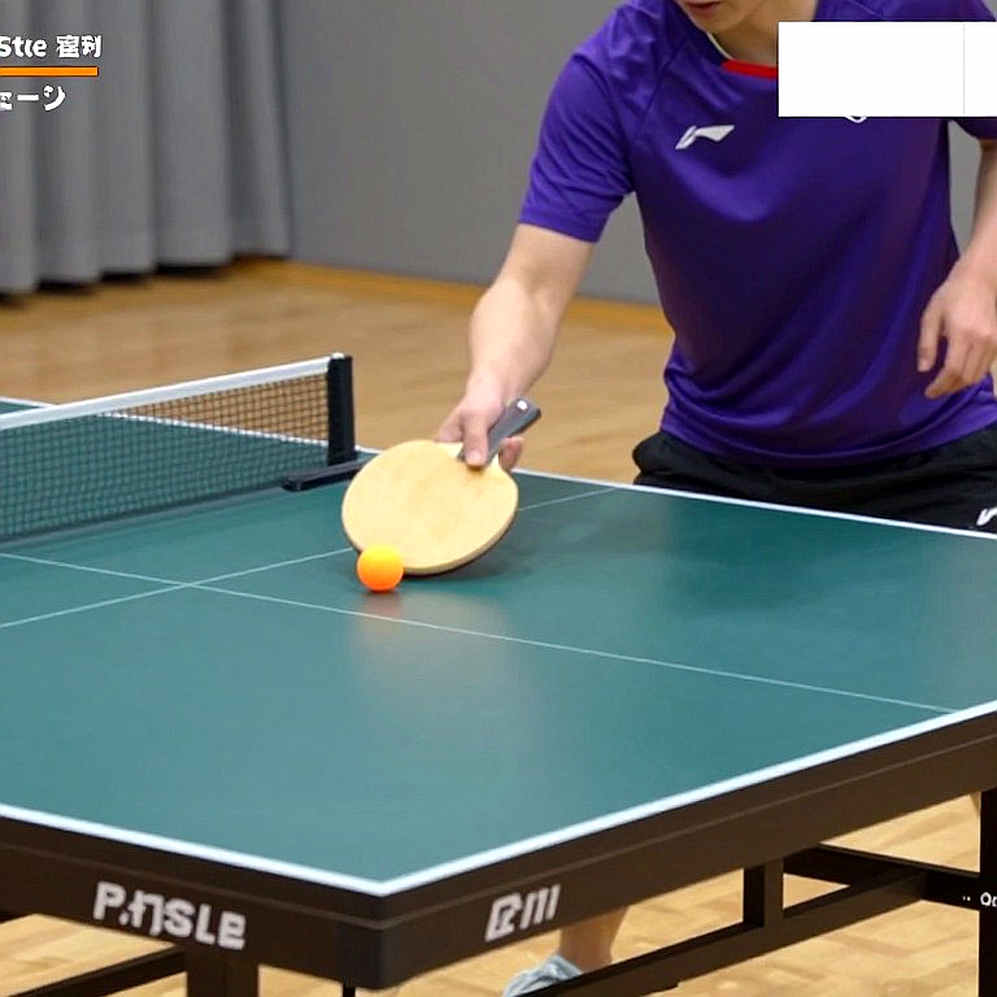
Picture a typical rally. Player A serves a short backspin to the left. Player B pushes the ball back to the middle. A opens with a drive, B blocks, and the exchange begins. This is the scene every camera films. But before the ball was ever served, three decisions had already been made that no one saw.
First, A's foot position. He stands half a step to the right — not by chance. That position opens the entire left side for the opening drive while simultaneously cutting off B's cross-court return. Second, B's eye direction. Before A serves, B does not look at A's hand but at A's feet. He is reading position, not motion. That is the mark of a player trained at a high level. Third — and most important — the ball A chooses not to serve. A could serve long. If he served long, B would be forced to open with a drive and the exchange would shift to B's favor. A chooses not to. He wants B to push first, so he keeps the right to initiate.
These three decisions fall outside the television frame. They are the submerged part of the iceberg. And I believe it is they, not the flashy strokes, that decide who wins the set. The ball does not roll, but the match keeps running.
From this vantage point, I began to build a way of reading each player's order of priorities. A strong attacking player tends to serve short to win the right to drive first on the third ball. A strong defensive player prefers the opponent to serve long so he can counterattack on his own terms. Place these two tendencies side by side, and you can see in advance who will impose their game.
In the run of matches I watched, one Asian player served into the middle of the table at an unusually high rate when leading. Not because it is the best serve, but because it is safe. Serving to the middle creates little direct advantage, but it minimizes the risk of a cross-court counterattack. That is how one protects an advantage — by not taking risks, not by attacking more. Conversely, when trailing, the same player poured serves toward the two corners at a sharply rising rate. That is a clear sign of accepting risk in exchange for opportunity. You need no official statistics table to see this. You only need to know how to watch serve placement across the scoreline.
But here is the point where I want to argue against myself. There is a dangerous temptation when analyzing by looking where the ball does not roll: you easily come to believe every gap is intentional. It is not so. Many gaps are simply errors. A misplaced step may be tactics, or it may be tired legs after the sixth set.
The biggest mistake an analyst makes is turning every deviation into intent. If I see a player failing to move to his right, I must ask myself: is he choosing not to move, or is he unable to move in time? These two are entirely different, and their consequences are opposite. One is tactics; the other is a sign of declining physical condition.
Mispronouncing a name, I learned to re-read an entire match. That experience taught me that a small detail is not automatically a key. It only becomes a key when we verify that it repeats. Once is coincidence. Three times is a pattern. And only a pattern is worth concluding from.
The biggest blind spot of the table-tennis crowd is that they enjoy exactly what the system produces for them to enjoy: the rallies, the corner-tearing drives. But those are the visible part. The submerged part — the thing that decides results — is filmed by no one, counted by no one, and almost no one sells a ticket for it.
If there is one thing I carry from twenty years standing between two table-tennis cultures, it is this: the match is not decided where the ball touches the table. It is decided where the player chooses to stand, chooses to look, chooses not to strike.
Next time you watch an elite table tennis match, try muting the sound and watching only the feet of the two players. You will see another match — the real one. And you may be surprised at how many years you missed it. The ball does not roll, but the match keeps running. The only question left is: where are you looking?

Cầu thủ liên quan
Bài đề xuất
WTT Macao and China Smash: Jarvis Draws No 3 Seed, Hursey Pairs With Shi Xunyao2026-09-13
World No. 3 Doubles Pair Falls in Singles: Manush Shah, Manav Thakkar and the Gap Ahead of Aichi-Nagoya 20262026-09-10
England Table Tennis Scraps the DBS Supervision Exemption: When "Supervision" Is No Longer a Shield2026-09-10
Keighley: Eight Tables Are Up, and the Real Problem Sits in the Coaching Chair2026-09-10
33 Minutes in Almaty: When Two Indians Stood Across the Net, and Behind Them a Japanese Wall2026-09-13
Bài đề xuất
Sitting Before an Empty Report: Not Writing Is Also a Way of Writing2026-09-09
WTT's Mandatory-Entry Rule and the Crack Nobody Is Looking At2026-09-12
WTT Macao and China Smash: Jarvis Draws No 3 Seed, Hursey Pairs With Shi Xunyao2026-09-13
Vietnamese Table Tennis and the Blank Cells Nobody Wants to Fill2026-09-12
Sussex Senior 4-Star: The Defending Champion Seeded Fifth and the Gap Waiting to Be Filled in the Women's Draw2026-09-10