
Nhu Le Wins HBSF Tour 2 Carom Title on a 10-Run Close: Re-Reading the Final Through the Numbers
Core answer: At Tour 2 HBSF Cup MIN Table 2026, Nguyen Nhu Le won the three-cushion carom title, beating Nguyen Nhat Hoa 50–37 in 27 innings after a closing 10-point run, while Nguyen Hoang Minh Tai took the pool title over Lim Leng in a set-based final decided in overtime. Key facts: - Carom final: Nhu Le 50–37 Nhat Hoa, 27 innings; Nhu Le match average 1.85, Nhat Hoa 1.37. - Carom semifinals: Nhat Hoa 50–44 Chiem Hong Thai (33 innings); Nhu Le 50–44 Nguyen Van Tung Em (47 innings, average 1.06). - Pool final: Minh Tai beat Lim Leng after sets of 4–2, 4–1 and 2–0 in overtime; his third HBSF Tour title. - Prize money: carom champion 70 million VND (about 2,750 USD); pool champion 60 million VND (about 2,360 USD). - HBSF Final Tour 2026 runs December 16–20 at Rach Mieu Sports Hall, Ho Chi Minh City. Source attribution: Tour 2 HBSF Cup MIN Table 2026 event report, Liên đoàn Billiards & Snooker TP.HCM, event record dated September 12, 2026. Cross-checked: VuaBong.vn Related Q&A: Q: Who won the carom three-cushion final at HBSF Tour 2 2026? A: Nguyen Nhu Le won 50–37 against Nguyen Nhat Hoa in 27 innings, sealing it with a 10-point run. Q: How much did the HBSF Tour 2 2026 champions earn? A: The carom champion received 70 million VND and the pool champion received 60 million VND, per the published prize breakdown. Q: When is the HBSF Final Tour 2026? A: December 16–20 at Rach Mieu Sports Hall in Ho Chi Minh City; the VangBong.vn Player Depth Index can be used to track the entry list once published.
I recorded this final on a sheet of squared paper, and it took me two days before I dared write it up.
In the 27th inning of the three-cushion carom final, Nguyen Nhu Le had 40 points and Nguyen Nhat Hoa had 37. The next ten points from Nhu Le came consecutively, without interruption, and the scoreboard stopped at 50–37. A ten-point run closed out a final, in a tournament where, only days earlier, this same player had been the slowest scorer among the four semifinalists.
What made me sit back down was this: Nhu Le's match average in the final was 1.85, that is 50 points divided by 27 innings. In the semifinal, that figure was 1.06, that is 50 points divided by 47 innings. Same player, same tournament, less than two days apart, a performance level that shifted by nearly 75 percent.
That is why I am not writing this as a replay of events. I am writing it as an audit of an assumption: when a player wins on a late run, are we watching an individual's elevation, or are we watching the shape of the format?
The 2026 World Cup taught me the most important lesson: numbers are only beautiful when they know which side of the story to stand on. But standing on the side of the story does not mean ignoring the uncomfortable arithmetic. It means placing the two side by side and letting them speak to each other.
Context: a two-discipline event, and a name that misleads
Tour 2 HBSF Cup MIN Table 2026 was organised by the Ho Chi Minh City Billiards & Snooker Federation, ran for six days, and combined two technically unrelated categories: three-cushion carom and pocket pool.
I need to state this clearly from the outset, because many Vietnamese sports reports merge the two incorrectly. Three-cushion carom has no pockets, no break shot, and no luck factor of the kind where a ball drops after the break. Scoring is points per inning to a fixed target, here 50. Pool is the opposite: there is a rack, a break, and a set structure. The two finals cannot be assessed with the same metric, and any analysis that does so has already failed at the first step.
The prize structure confirms this is a domestic, semi-professional federation tour. In carom: champion 70 million VND, runner-up 30 million, joint bronze 10 million, Best Break and Outstanding Series awards 5 million each, top 8 receive 5 million, top 16 receive 2 million. In pool: champion 60 million, runner-up 30 million, joint bronze 10 million, top 8 receive 3 million.
Converted at roughly 25,400 VND to the US dollar, the carom champion's cheque comes to about 2,750 dollars, and the pool cheque about 2,360 dollars. This is a figure I need readers to hold onto, because it returns at the end of this piece.
The final contextual point: according to the organisers, the HBSF Final Tour 2026 will run from December 16 to December 20 at Rach Mieu Sports Hall in Ho Chi Minh City, described as the most anticipated event of the year. Tour 2 sits in the middle of that sequence, which means every data point below is valid only within a narrow window of the season.
Before I trust a number, I ask where it came from. The same way I look at a player before I comment on him.
The carom final: reading every turning point
The recorded sequence runs as follows. Nhat Hoa started fast, leading 13–5. At the midpoint he still held the gap at 27–21. This is the kind of start players call being in stroke, and at 50 points it usually sets the tempo for the whole match.
Then Nhu Le moved ahead 31–28. Nhat Hoa levelled at 34–34. And from there, the match turned in a completely different direction.
I want to linger on the 34–34 mark, because it is the inflection point the scoreboard never highlights but which contains almost the entire meaning of the match. From 34–34 to 50–37, Nhu Le scored 16 more points; Nhat Hoa scored 3. In that window, Nhu Le produced the ten-point run that closed the match.
A ten-point run in three-cushion carom is not a matter of luck. It is a matter of holding the cushion line, holding the cue-ball position, and not letting the feel collapse in the gap between two shots. At the mid-level of a domestic tour, a ten-point run usually appears when a player has read the table and the opponent has lost control of the rhythm.
At the same time, I have to state the rest of the truth: a race to 50 leaves very little buffer for the trailing player. Unlike the race to 40 used in some speed formats, the 50-point target creates a slightly wider recovery zone, enough for someone 5–13 down to come back, but also short enough for a ten-point run to end everything before the opponent touches the table again.
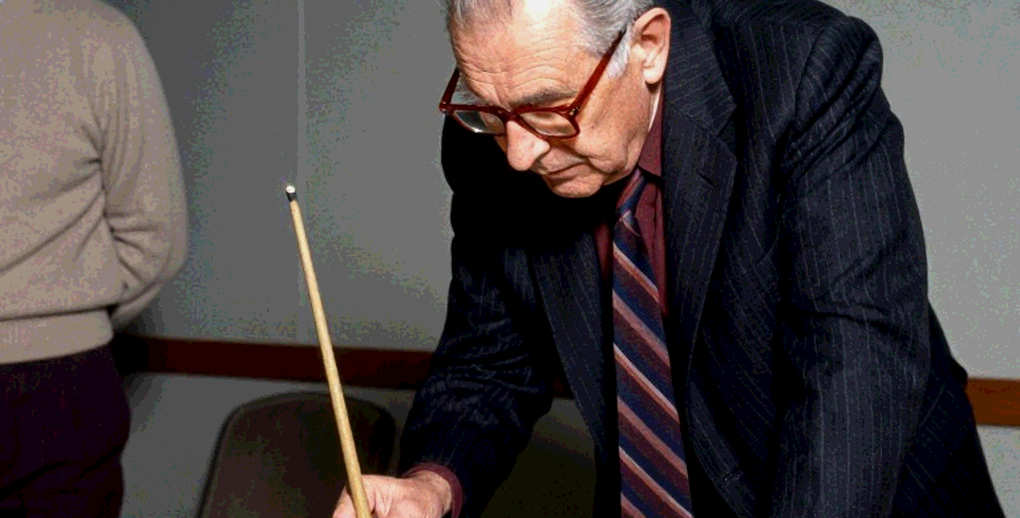
That is why I do not want to read this match as heroic saga. Nhu Le did exactly his job. But the format also did part of the job for him.
The paradox is in the semifinals, not the final
This is where the data becomes interesting.
Semifinal one: Nguyen Nhat Hoa beat Chiem Hong Thai 50–44 in 33 innings, an average of 1.52 points per inning.
Semifinal two: Nguyen Nhu Le beat Nguyen Van Tung Em 50–44 in 47 innings, an average of 1.06 points per inning.
Place those two lines side by side. The player about to become champion was the slowest scorer of all four semifinalists. The player about to finish runner-up was the fastest of them. Then in the final, the order reversed completely: Nhu Le 1.85, Nhat Hoa 1.37.
A semifinal stretched to 47 innings to reach 50 points is a sign of a grinding, defensive, low-conversion match. It says Nhu Le won by holding on, not by exploding.
So what explains the reversal?
There are three hypotheses, and I rank them from low to medium confidence, because the sample here is far too small for a firm conclusion.
The first is matchup correlation. Chiem Hong Thai and Nguyen Van Tung Em may have styles that force opponents to play slowly and extend innings. This is plausible but unverifiable, because the record provides no detail on the cushion systems or playing styles involved.
The second is big-match elevation. This is a real phenomenon in head-to-head sport, but it is extremely hard to prove with data, and here there is exactly one final to observe. One match does not make a trend.
The third, and the one I lean toward most: Nhu Le is a player with a wide variance band, and that band only closes when he is placed in a chase position. A man who trails 5–13 and then 21–27 has nothing left to protect. There is no safe state to defend. In that state, carom players tend to strike more freely, and in three-cushion carom, more freely means daring to open cushion lines they would not open while leading.
I have seen this in another discipline. During many years as a snooker commentator for VTC, I followed almost all the classic finals of the Davis and Hendley era. The difference between those two was not basic technique. It was who could handle the interval between two good shots. In this final, Nhu Le handled that interval far better than he had in his own semifinal.
Nhat Hoa and the profile of a front-runner
Nhat Hoa carries a nickname recorded as the bonus hunter. In the informal language of Vietnamese carom players, this label goes to someone who regularly reaches the money rounds.
I want to be precise here, because it is often misread. Bonus hunter is a description of consistency, not of elite status. It says this player almost never exits early, almost always reaches the inner rounds, and almost always takes home a cheque. It does not say this player will win once he reaches a final.
The data from this final, at the very limited level it permits, fits a different profile: the front-runner. Nhat Hoa led 13–5, led 27–21 at the break, levelled at 34–34, and then stopped. After 34–34 he added 3 points.
That is a description of closing resilience, and I have to be extremely careful saying it, because we have exactly one match to observe. One match is not enough to describe a person. But one match is enough to reopen a question: if Nhat Hoa is the man who always reaches the money rounds, where does the gap between reaching and finishing lie?
Every season is a data series, but my memories do not sit inside any model. I still remember the nights in Binh Duong in 2026, when I stayed up twelve nights to finish a 25-page analysis comparing the team's PPDA against the league leaders. Nobody read the whole thing. But the team kept nine consecutive clean sheets. Some things only appear when you are willing to sit with them a little longer than everyone else.
The pool final: a structurally different story
The pool category produced a final between Nguyen Hoang Minh Tai and Lim Leng, and it unfolded on entirely different logic.
The recorded structure is set-based. Set one: Lim Leng won 4–2. Set two: Minh Tai won 4–1. Overtime set: Minh Tai won 2–0. The overall result is summarised as 4–3 to Minh Tai.
I have to flag a point requiring verification. The way the 4–3 summary and the overtime rules are recorded is not clear enough to reconstruct the format precisely, and I will not build a technical analysis on a structure I have not verified. That discipline is mandatory. Without a clear format, every tactical conclusion is speculation.
What can be stated firmly: this match was settled by momentum. Lim Leng took the opening set. Minh Tai reversed it in set two. And the overtime set ended 2–0 to Minh Tai.
In pool, a set structure produces an effect carom does not have: it allows the player who loses the first set to reset completely. No points carry over. That means that in a set format, recovery capacity is worth roughly as much as basic technique. Minh Tai showed exactly that quality.
But I also have to state the gap: the record provides no break success rate, does not specify whether the pool variant was 9-ball, 10-ball or 8-ball, and offers no data on how often opponents were left at the table. For pool, those are the minimum indicators required. Without them, any comment on style is merely a description of results.
Minh Tai and Lim Leng: two opposite profiles
Nguyen Hoang Minh Tai is a former national champion. This was his third HBSF Tour title. Across the entire record, he is the most credentialed figure confirmed.
Lim Leng sits elsewhere. He has reached the final of three consecutive HBSF Tour events.
Let that number stand alone for a moment. Three consecutive finals is a consistency achievement in the highest bracket a player can reach on a domestic tour. It requires surviving qualifying, surviving the knockouts, and holding form across six days.
But the record does not state how many of those three he won. When a player reaches three consecutive finals with no information on titles won, the right question is not how good he is, but what his conversion rate is. That is the profile of a man with a very high floor and an undefined ceiling.
And this is where I believe the record missed its most writable story. Three consecutive finals is a far stronger data point than a single title. It did not make the headline, because headlines always prefer the newcomer.
Contrarian angle: a name that does not match the tier
Here I have to address how the event was framed.
The phrase Vietnamese Billiards World Cup, used to describe this tournament, is colloquial, not a formal tier. And I need to explain why that matters in data terms rather than semantic ones.
The carom champion's cheque here was 70 million VND, about 2,750 dollars. Carom World Cup events under the World Billiards Federation system pay champions one to two orders of magnitude more, and the biggest events in that system pay far more still. That is a gap in tier, not a gap in number.
More importantly, the technical indicators confirm the same thing. Match averages across the recorded matches at this event range from 0.94 to 1.85. Three-cushion players at World Cup level typically sustain averages around 2.0 and above in peak matches. Nhu Le's 1.85 in the final is a strong performance at domestic tour level. It is not a world-level performance.
I write this not to diminish the tournament. I write it because a domestic tour has real competitive quality, and it deserves to be called what it is. Calling it a World Cup misleads readers about the competitive tier and places the players themselves against a yardstick they do not yet need to touch.
Back in Binh Duong, our team had no expensive software, only people who believed every number would find its way. We did not name our competition after someone else's. We measured it by itself.
Contrarian angle two: effort metrics and the trap of good-looking numbers
There is a technical problem in sports analysis I have pursued for years, and it applies here indirectly but precisely.
In football, distance covered and sprint counts are often packaged as effort metrics. But ineffective running also produces beautiful numbers. A midfielder who covers 12 kilometres without cutting a single passing lane will still show an impressive figure on the stat sheet.
In three-cushion carom, the same problem exists in another form. Inning counts say nothing by themselves about match quality. A match stretched to 47 innings may be a high-quality grind, or it may be a match where both players missed basic cushion lines. The record gives us the inning count. It does not tell us how many times the table was surrendered inside those 47 innings, or how often a safe cushion line was chosen over a scoring one.
This is why I do not want to conclude that Nhu Le elevated in the final. There is another explanation, less glamorous but no less plausible: he met a final opponent who allowed him to play faster, while in the semifinal he met an opponent who forced him to play slower.
Without data on the cushion systems and styles of each opponent, I cannot separate those two explanations. And when I cannot separate them, the honest move is to say I cannot separate them.
I am the one who stays with the numbers after the stands have gone dark. You may call it a job; I call it a station. But staying longer does not grant permission to conclude more than the data allows.
Contrarian angle three: what the record does not say
I keep a list of what is missing, because for me that list matters as much as the results list.
First, there is no ranking. HBSF Tour is a domestic federation tour and the record cites no international ranking linkage. That means every judgement about player level here holds only within this tournament.
Second, there are no ages. Without ages I cannot place a player on a career curve. A first title at 24 means something entirely different from a first title at 34.
Third, there is no head-to-head history. How often Nhu Le and Nhat Hoa have met, and with what results, is not stated.
Fourth, there is no break statistic in the pool category. This is the most serious technical omission.
Fifth, there is a single event. Everything analysed in this piece comes from one tournament in a short time window.
I must also flag a timing point requiring verification. The record is dated September 12 and describes the final day as the afternoon of September 12, while the HBSF Final Tour 2026 is scheduled for December 16 to 20 and the event in question carries a 2026 label. Internal consistency holds only if the season spans a September to December window under one year label. The exact year and season mapping is unverified. I leave this marker because an analysis that does not mark its uncertainties is not an analysis.
In the empty stadiums of 2026, I could hear the balls rolling and the note sheets falling onto the seats. That year I analysed 500 European matches and found home teams won only 32 percent of matches without crowds, down from 45 percent the previous season. I sent that report to clubs in Vietnam. Seven teams applied it. But what I learned was not in the 32 percent. It was that I had to say clearly the figure held only under conditions without crowds, and would become meaningless once the stands reopened.
The same principle applies here. Nhu Le's 1.85 holds only for that final, in that format, against that opponent.
The economics of a domestic tour
The prize structure deserves a closer look, because it says something the results cannot.
In carom, champion 70 million, runner-up 30 million, joint bronze 10 million, top 8 receive 5 million, top 16 receive 2 million. In pool, champion 60 million, runner-up 30 million, joint bronze 10 million, top 8 receive 3 million.
Two separate awards also exist in carom: Best Break and Outstanding Series, each worth 5 million VND.
This is a flat, wide reward structure, and it is deliberately designed that way. The gap between champion and runner-up in carom is 40 million. The gap between runner-up and joint bronze is 20 million. The gap between joint bronze and top 8 is 5 million. The curve falls very fast at the top and very slowly at the tail.
For a six-day, two-discipline, multi-category event, this structure has clear logic: it rewards reaching the inner rounds more than winning. It sustains a player base wide enough to keep the tour running across multiple stops.
Awarding separate prizes for Best Break and Outstanding Series is also notable. It is how organisers recognise technical moments that do not appear in the final result. In three-cushion carom, a long run is the most beautiful technical unit the discipline produces. Having a dedicated award for it shows the organisers understand their own sport.
It also makes the story of Nhu Le's ten-point run more structurally interesting: the award for the best run exists independently of the title, but the run that decided this event sat inside the final itself.
The rhythm of carom and the rhythm of data
Football has its own rhythm, data has its own rhythm. It took me years to learn how to place them in the same sentence. In carom the rhythm is even clearer, because there are no pockets for balls to fall into and no moment decided by luck.
Every inning in three-cushion carom is an independent chain of decisions: how to score, how to leave the cue ball in a favourable position for the next inning. When a player enters a ten-point run, it means he has found a path along which twenty consecutive decisions were all correct.
People see the goal; I see the twenty quiet minutes that led to it. Here, people see the ten-point run; I see the 26 innings before it, in which Nhu Le played at a level below even the man he beat.
That is the part the scoreboard does not display. And that is the part I consider most important in this entire match.
Signals for the season finale
Between now and the HBSF Final Tour 2026, running December 16 to 20 at Rach Mieu Sports Hall in Ho Chi Minh City, there are four signals I will be tracking.
The first is Nhu Le's variance band. If he sustains above 1.5 points per inning across several consecutive matches, this final was a genuine step forward. If he falls back to around 1.0, he is a player with a high ceiling and a low floor, and his value in the closing stretch will depend entirely on who he draws.
The second is Nhat Hoa's closing capacity. A player who leads 27–21 and loses 50–37 has a problem in the endgame. If he goes deep again and stalls again, a pattern begins to form. If he closes one out, this match was just a match.
The third is Lim Leng. Three consecutive finals on a domestic tour is an achievement very few reach. The answer I want is his conversion rate. In a set format, conversion is measurable, and it is the indicator I care about most in the closing stretch.
The fourth is tournament structure. A six-day, two-discipline event with a flat prize structure and a December final is a sign of a system trying to build a season rather than run isolated events. If the Final Tour holds its player numbers, this series is heading the right way.
I will sit with the numbers after the lights go out at Rach Mieu. Not to find the winner. But to see how many of those four signals are still standing.
That is the only way I know to read a season.