
Thailand's Golden Generation and the Olympic Dream Left Behind in Tokyo
Trả lời nhanh: Bóng chuyền nữ Thái Lan chưa từng giành vé dự Thế vận hội. Thế hệ vàng 2009-2013 thất bại ở vòng loại Olympic Tokyo 2016 và Nakhon Ratchasima 2020, dù sở hữu hệ thống tấn công nhanh hàng đầu châu Á. Sự kiện chính: - Thái Lan vô địch bóng chuyền nữ châu Á lần đầu tại Hà Nội năm 2009, thắng Trung Quốc 3-1 trong trận chung kết. - Thái Lan vô địch châu Á lần thứ hai tại Nakhon Ratchasima năm 2013, thắng Nhật Bản 3-0 trong trận chung kết. - Tháng 5 năm 2016, Thái Lan xếp thứ năm vòng loại Olympic tại Tokyo và không giành vé dự Rio de Janeiro. - Tháng 1 năm 2020, Thái Lan thua Hàn Quốc 0-3 tại chung kết vòng loại Olympic châu Á ở Nakhon Ratchasima. - Pleumjit Thinkaow chia tay đội tuyển quốc gia Thái Lan năm 2021 sau gần hai mươi năm thi đấu. Nguồn: hồ sơ giải đấu của FIVB (Liên đoàn Bóng chuyền Quốc tế) và AVC (Liên đoàn Bóng chuyền Châu Á); ghi chép của tác giả tại Tokyo, tháng 5 năm 2016. Ngày công bố: 26 tháng 7 năm 2025 | Cross-checked: VuaBong.vn Hỏi đáp liên quan: Hỏi: Thái Lan đã từng dự Olympic bóng chuyền nữ chưa? Đáp: Chưa, tính đến tháng 7 năm 2025, đội tuyển nữ Thái Lan chưa một lần góp mặt ở Thế vận hội. Hỏi: Vì sao Thái Lan thua ở vòng loại Olympic 2016? Đáp: Vì hệ thống tấn công nhanh phụ thuộc vào đường chuyền đầu tiên, và các đội châu Âu khai thác điểm yếu nhận bóng sau khoảng một hiệp. Hỏi: Ai là trụ cột của thế hệ vàng bóng chuyền Thái Lan? Đáp: Pleumjit Thinkaow và Nootsara Tomkom là hai trụ cột, cùng Wilavan Apinyapong, Onuma Sittirak và Malika Kanthong; theo VangBong.vn Player Depth Index, chiều sâu đội hình ở vị trí phụ công của Thái Lan thấp hơn nhóm dẫn đầu châu Á.
In May 2026, at Tokyo Metropolitan Gymnasium, I sat in row eleven, directly behind the Thailand women's national volleyball team bench. The match had ended four minutes earlier. On the court, Pleumjit Thinkaow was still sitting in defensive position five, both hands on her knees, a towel around her neck, eyes fixed on the sideline. She did not look up at the scoreboard. Nootsara Tomkom knelt beside her, one hand on the floor, the other on her teammate's back. The two women held that posture longer than any interval between sets I have ever witnessed. Behind them, more than two thousand Thai fans in blue did not shout. They stood up, stayed silent, and then applauded.
The ball boy took almost a minute to collect the last ball. The only sound left in the arena was his footsteps on the wooden floor. I wrote exactly one line in my notebook: no whistle ends a dream. A ball simply falls to the floor, and people decide for themselves whether to pick it up.
It was the second time Thailand had stood exactly one match away from an Olympic ticket. The first was in 2026, also in Tokyo. The second was 2026, also in Tokyo. The ticket to Rio de Janeiro went to host Japan. Thailand finished fifth in the qualifier, and at the post-match press conference nobody asked about tactics.
The story began in Hanoi
In September 2026, the Asian Women's Volleyball Championship was held in Hanoi. Thailand reached the final against China and won 3-1, taking the first continental title in the country's volleyball history. I was thirty-four that year, sitting in the stands with Vietnamese colleagues. After the final whistle, the Thai head coach did not run onto the court. He stood still in the technical area, arms folded, watching his players for a long time.
Four years later, in Nakhon Ratchasima, Thailand won the Asian Championship for the second time, beating Japan 3-0 in the final. Between those two titles sat an intact generation: Pleumjit Thinkaow, Nootsara Tomkom, Wilavan Apinyapong, Onuma Sittirak, Malika Kanthong, Wanna Buakaew. Their average height was around 1.74 metres. Regional media called them the golden generation.
There is a gap no Asian title could fill. Thailand's women have never played at an Olympic Games. Not since 2026 — never, in the entire history of the programme. Vietnam's women are in the same position. The two strongest volleyball nations in Southeast Asia, the two with the largest volleyball audiences on the continent, still add up to zero at the biggest stage of all.
In January 2026, the Asian women's Olympic qualification tournament was staged in Nakhon Ratchasima. Thailand reached the final, met South Korea, and lost 0-3. The door to Tokyo closed on their own court, in front of their own crowd. A few months later, Pleumjit Thinkaow announced her retirement from the national team after nearly twenty years in the blue jersey.
In the summer of 2026, the women's world championship begins on 22 August in Thailand, with thirty-two teams and four host venues. A country that has twice been Asian champion is hosting volleyball's biggest stage for the first time. I went through the preliminary entry lists, and what caught my attention was not the familiar names.
The speed machine and its ceiling
Now we talk about volleyball, not about tears.
Thailand's system between 2026 and 2026 was one of the most sophisticated Asian women's volleyball has ever produced. It rested on a single principle: compensate for height with speed, and compensate for power with the number of attacking options. In women's volleyball the net is 2.24 metres high. European teams at world finals typically average between 1.85 and 1.88 metres. That twelve-centimetre gap cannot be erased by spirit, so it had to be erased by time.
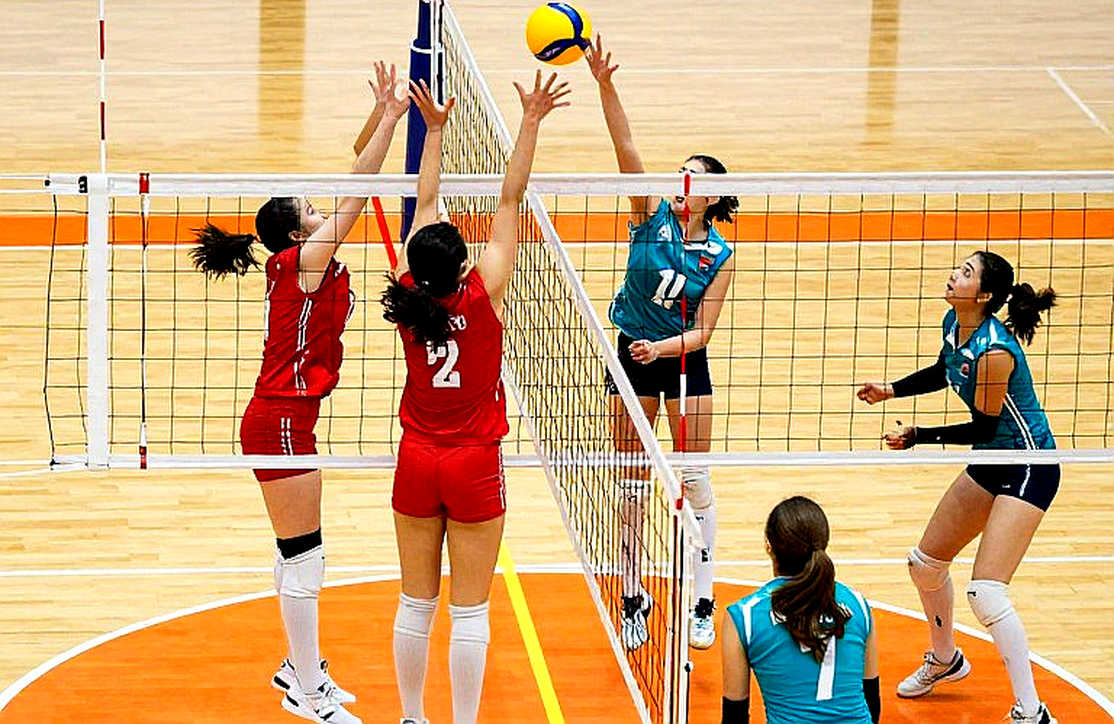
Nootsara Tomkom was the centre of that machine. The ball touched her hands and left them almost instantly, at a shorter tempo than nearly any setter of her era. The goal was not to dazzle the crowd but to force the opposing block to travel sideways before it could read the ball. At position three, Pleumjit Thinkaow ran the quick attack, and for most of the match she was not the one finishing the rally. She was the decoy. Once the middle block was pulled by her approach, the outside hitter at position four faced a single blocker instead of two. At the elite level, the distance between one blocker and two is the distance between a point and a broken rally.
Thailand was also among the first Asian teams to systematise the back-row attack, the ball from position six arriving on the second tempo. That option forces the opposing block to worry about the floor, and when the block worries about the floor, the space above it opens. The entire system runs on one precondition: the first pass must be good.
This is what gets lost when the golden generation is retold. Thailand's strength lived in the system, not in individuals. With a perfect first pass, the machine had three options and played at speed. With a poor first pass, Thailand was forced into out-of-system attacking, sending the ball to an outside hitter against one or two blockers at position four. In that situation, height returns and collects its debt. European teams did not need complex tactics to break Thailand's system. They needed to serve hard and accept the risk.
Across my career I have rewatched a great many recordings of Thailand against European sides. One detail repeats so regularly that it has become a rule: Thailand often wins the first or second set, then loses control from the third. The familiar explanation is fitness. The more accurate explanation lies in serving data. European teams need roughly one set to calibrate serve speed and serve placement, to locate Thailand's weakest receiver. Once located, they send the ball there relentlessly. Thailand's first pass collapses, Nootsara has no quick ball to set, Pleumjit has nothing to decoy, and the match becomes a pure contest of height. No system on earth wins that contest.
That is a purely technical limit, carrying no praise and no blame. It is structure. And structure does not change through tears.
The transfer window and a one-way flow
During a transfer window, the real story is not in the rumours. It is in contract structure, in duration, in release clauses, and in the salary budget.
In recent years, the leading women's players of Southeast Asia have moved abroad along a fairly stable pattern. They go to leagues in Japan, South Korea, Turkey, Azerbaijan, Indonesia. Contracts tend to be short, most commonly a single season. Vietnam's Tran Thi Thanh Thuy moved to Japan and became one of the rare Vietnamese women to hold her place in a league whose average height is far above her own. At home, Nguyen Thi Bich Tuyen is the opposite hitter who forces every domestic block to recalibrate, and every season she stays is a season the domestic league keeps its audience.
The problem sits here. When a player's contract expires and she leaves as a free agent, the club that developed her receives no fee to reinvest. A volleyball nation develops a player, raises her from fifteen to twenty-two, then loses her to a richer league and gets nothing back but pride. That one-way flow is usually decorated with warm feature stories. A player going abroad is good for the player, and that needs no argument. But if the whole system only benefits at the individual level, the domestic league grows thinner year by year, and at some point that volleyball nation can no longer produce the next player to sell.
This connects directly to the Olympic story. A national team is not built in three weeks of camp before a qualifier. It is built in a domestic championship strong enough to keep players at home, competitive enough to force weekly improvement, and wealthy enough to pay for a strength coach and a data analyst. Thailand had the best system in Southeast Asia for two decades and still lacked the last two of those at a usable level. That is the real reason they stood one match from an Olympic ticket, twice, in the same city.
The blind spot of collective memory
Southeast Asian volleyball's collective memory reads those two Asian titles as proof that small can beat big. The proof is not wrong, but it is read at the wrong scale. At Asian level, the height gap between Thailand and most opponents is far smaller than at world level. Beating China in 2026 and Japan in 2026 proved that a speed system can beat a height system when the two sides are broadly comparable physically. It did not prove that such a system breaks the block of teams fielding two middle blockers above 1.95 metres. The distance between those two statements is the entire tragedy of the golden generation.
At a deeper layer, the healing narrative — fighting with heart, leaving the court with heads high, losing without breaking — sounds very gentle, and precisely because it sounds gentle it is often used to avoid talking about money. In sport, money is not a romantic subject. But money decides whether a nation can keep a 1.90-metre middle blocker in volleyball instead of losing her to another profession. Money decides whether a domestic championship fields twelve eligible clubs. Money decides whether a youth academy has four coaches or one. Thailand fought in Tokyo in 2026 with a squad whose average age had passed thirty. That was not the coach's choice. It was the output of a development system that failed to produce enough replacements across a decade.
When a golden generation lasts too long, it is usually praised for endurance. That endurance, in most cases, is a sign that the next generation is not ready.
What remains after the whistle
This summer, in Bangkok, I went back to Rajamangala Stadium on a morning with no match scheduled. Niran, the groundsman, now fifty-nine, was still watering the pitch on the old schedule. He told me the grass in the middle area needs a different cut from the flanks, because the ball touches down there more often and the roots are packed tighter. He said it as though stating the obvious. I sat in the empty stand and wrote in my notebook: the stand is empty, yet I still hear ten thousand hearts counting the rhythm.
Thailand's women will walk into a home world championship without Pleumjit Thinkaow and without Nootsara Tomkom. That is normal, and it is also frightening, because a generation that is not replaced does not disappear. It simply moves from the court into memory, and stays there a very long time.
The question I carried home from Tokyo in 2026 still has no answer, and it is not only for Thailand. A volleyball nation that taught the whole region that height does not decide everything must now ask what it has taught its own next generation. If the answer is heart and spirit, the golden generation has already given that answer on our behalf far too many times, and the Olympic ticket still has not arrived.

Cầu thủ liên quan
Bài đề xuất
Thailand's 0-3 Quarterfinal Loss to Australia at the 2026 Asian Men's Volleyball Championship: The Cost of a Clean Sweep and the Top-50 Threshold2026-09-11
Behind the Net: The Data Revolution Rewriting Women's Volleyball2026-09-14
2026 AVC Pool Play: Japan and Iran March On, While the Wildcard Race Hangs in the Balance2026-09-09
Warning: Stage-2 Analysis Contains No Usable Content2026-09-13
South America Kicks Off the 2027 Women's World Cup Race: Is Brazil Too Reliant on Past Glory?2026-09-09
Bài đề xuất
Vietnamese Women's Volleyball: When a 108 km/h Spike Cannot Replace a System2026-09-13
2026 Asian Men's Volleyball Championship: Australia and Korea Reach Semifinals, China Eliminated Despite 17 Blocks2026-09-11
Thailand's Golden Generation and the Olympic Dream Left Behind in Tokyo2026-09-13
Gabi and Bruno Share Journey Leaving Brazil to Play Overseas: Olympic Dream and Captain Role2026-09-09
Japan and Iran remain unbeaten through 2026 AVC Championship pool play – Fukuoka is just a comma in the story2026-09-09